Scientists have long observed a peculiar phenomenon surrounding Earth’s moon: a vast, asymmetrical dust cloud that consistently trails behind it. Now, a new study offers a compelling explanation for this curious asymmetry, linking it to the extreme temperature differences between the moon’s sunlit and shadowed sides.
The Lunar Regolith: A Constant Barrage of Dust
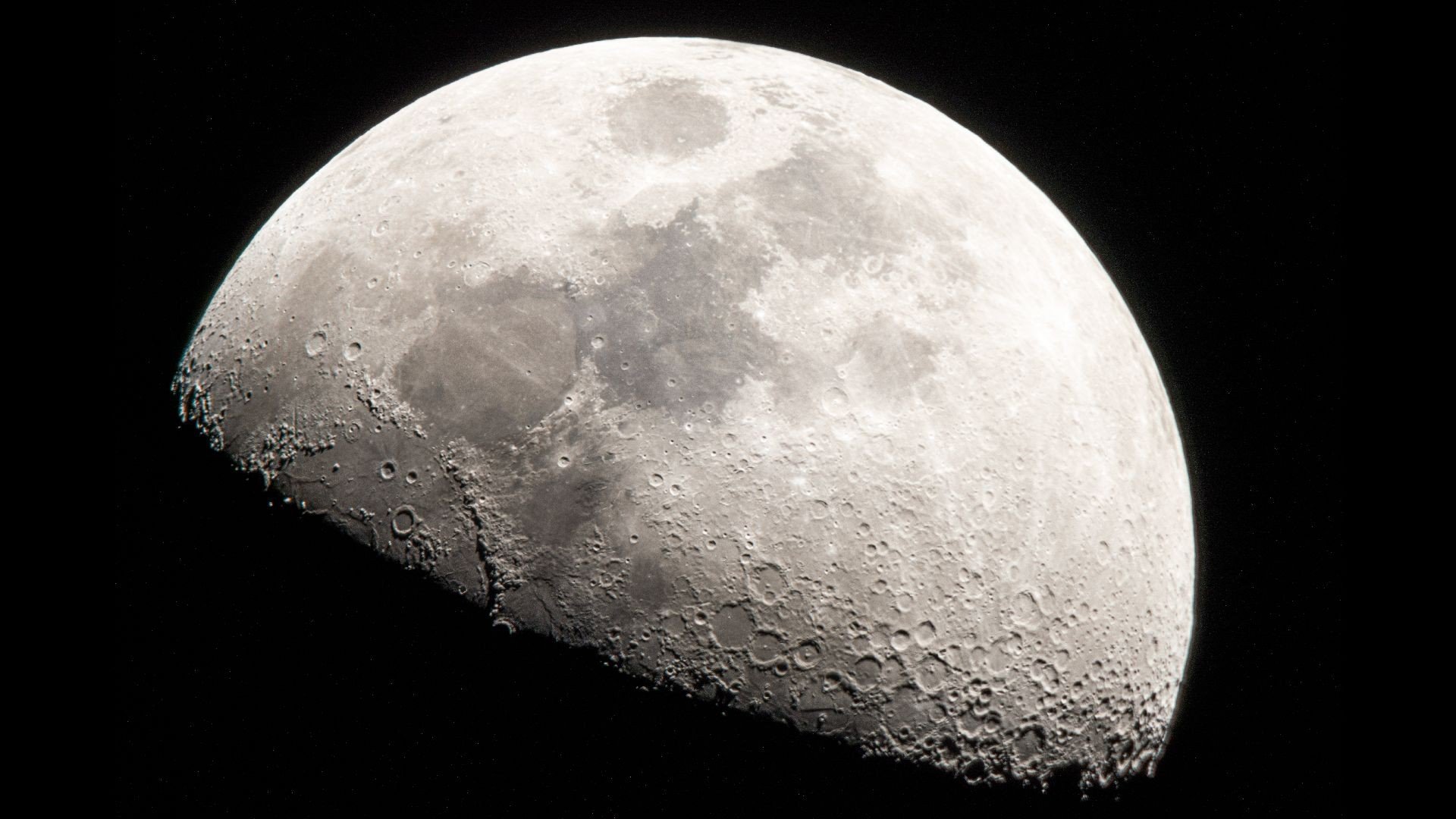
The moon’s surface isn’t a smooth, solid landscape. Instead, it’s blanketed by a layer of gray dust and loose rocks called regolith. This regolith is continuously generated by a relentless bombardment of micrometeoroids – tiny space rocks resulting from asteroid and comet collisions. Because the moon lacks an atmosphere to burn up incoming space debris (a phenomenon that creates “shooting stars” on Earth), tons of these micrometeoroids impact the lunar surface daily, grinding the rocks into fine dust.
A Massive, Asymmetrical Dust Cloud
In 2015, researchers discovered that the impact of these micrometeoroids doesn’t just create dust; it lifts it into space. This process generates a massive dust cloud extending hundreds of miles above the lunar surface. While not visibly thick, the cloud exhibits a striking asymmetry: it’s denser over the moon’s sunlit side – the side facing the sun at any given moment – than its darker counterpart. Notably, “the cloud is densest close to the surface near the dawn terminator,” — the dividing line between sunlight and shadow — according to Sébastien Verkercke, a postdoctoral researcher and the study’s lead author. The dust density is incredibly low, “the maximum density measured was only 0.004 particles per cubic meter (the equivalent to 4 dust grains in a grain silo).”
The Temperature Connection: A New Hypothesis
Initially, scientists attributed the cloud’s lopsidedness to specific meteoroid trajectories that favored impacts on the daytime surface. However, the drastic difference in temperature between the lunar day and night struck researchers as a potentially crucial factor. The moon’s surface can reach scorching temperatures, significantly hotter than the Earth’s hottest spots, while the lunar night plunges to temperatures colder than those found in Antarctica. Verkercke and his colleagues hypothesized that this extreme temperature swing – a difference of up to 545 degrees Fahrenheit (285 degrees Celsius) – might be responsible for the cloud’s asymmetric shape.
Computer Simulations Reveal the Truth
To test this hypothesis, Verkercke and his colleagues, a team of researchers from U.S. and European universities, employed computer models. The simulations tracked minuscule meteoroids (roughly the width of a human hair) impacting lunar dust at two different temperatures: 233 degrees Fahrenheit (112 degrees Celsius) and minus 297 degrees Fahrenheit (minus 183 degrees Celsius), representing the moon’s average daytime and pre-dawn temperatures, respectively.
Furthermore, the models considered the density or “fluffiness” of the lunar surface, as “the ejected dust grains are then individually tracked to monitor their distribution in space.” The simulations revealed that meteoroids impacting “fluffier” surfaces ejected less dust, due to the cushioning effect. Conversely, impacts on more compact surfaces generated more dust particles traveling at slower speeds.
Key Findings: Dust Density and Temperature
The study’s results strongly support the temperature hypothesis. They found that daytime meteoroids lifted 6% to 8% more dust than nighttime ones. Moreover, a larger proportion of the dust particles created at higher temperatures possessed sufficient energy to reach orbiting satellites capable of detecting them. “Both the larger amounts of lofted dust and the bigger fractions of dust reaching the satellites could explain the daytime dust excess,” the researchers concluded.
Future Research: Expanding to Other Worlds
The team’s research provides a significant step forward in understanding the dynamics of lunar dust and its impact on the space environment. They plan to extend their analysis to other bodies in the solar system that are similarly bombarded by small meteoroids. One particularly interesting target for future study is Mercury, given its even hotter daytime surface and greater temperature contrast between day and night, which would likely produce an even more pronounced asymmetry in its dust cloud.