


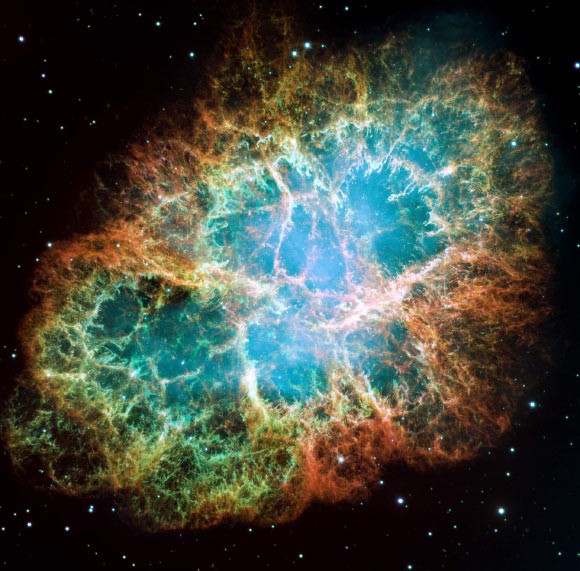
For decades, astronomers have puzzled over the distinct “zebra stripes” in the radio emissions from the Crab Pulsar—the remnant of a supernova observed over a thousand years ago. New research from the University of Kansas has finally untangled the physics behind this phenomenon, revealing that it’s not just plasma dynamics, but also the warping effect of gravity that creates these unusual patterns.
A Supernova Seen Through Time
The Crab Pulsar is the remnant of a star that exploded in 1054 CE, an event recorded by astronomers across multiple cultures, including the Chinese, Japanese, and Native Americans. The resulting nebula, now known as the Crab Nebula (or Messier 1), is approximately 6,500 light-years away in the constellation Taurus. First noted in 1731 and later rediscovered by Charles Messier in 1758, the nebula’s striped pattern has remained a key question in astrophysics.
The ‘Tug-of-War’ Between Gravity and Plasma
The Crab Pulsar’s radio emissions aren’t random. Instead, they appear as sharp, distinct bands with complete darkness in between—a zebra-like pattern unlike any other pulsar. The key to understanding this, according to University of Kansas Professor Mikhail Medvedev, lies in the interplay between gravity and the pulsar’s plasma.
Gravity warps spacetime: Light doesn’t travel in straight lines near massive objects. Instead, gravity bends its path like a lens. While gravitational lensing is well-understood in the context of black holes, this is the first case where astronomers have observed this effect combined with the influence of plasma.
Plasma defocuses, gravity focuses: The pulsar’s magnetosphere contains plasma that tends to spread light rays outward. Simultaneously, gravity pulls them inward. When these two opposing forces align, they create interference patterns – bright bands where signals reinforce each other and dark bands where they cancel out.
A Unique Interference Pattern
Earlier models could reproduce the stripes, but not with the striking contrast observed in the Crab Pulsar. By factoring in Einstein’s theory of gravity, Professor Medvedev has now provided a complete explanation. The combination of plasma and gravity creates interference bands of radio-wave intensity that appear as the pulsar’s zebra stripes.
“The previous theoretical model could reproduce stripes, but not with the observed contrast. The inclusion of gravity provides the missing piece.” – Mikhail Medvedev
This research has implications for our broader understanding of neutron stars, supernovae, and nebulae. The Crab Pulsar is a relatively close and easily observed example, offering astronomers a unique laboratory for studying these phenomena. While some refinements may be necessary to account for the pulsar’s rotation, the core mechanism behind the stripes appears to be fully explained.
The new study is set to be published in the Journal of Plasma Physics and is currently available on arXiv (arXiv: 2602.16955). The findings confirm that the universe continues to reveal its secrets through the combined application of established physics and precise observation.


