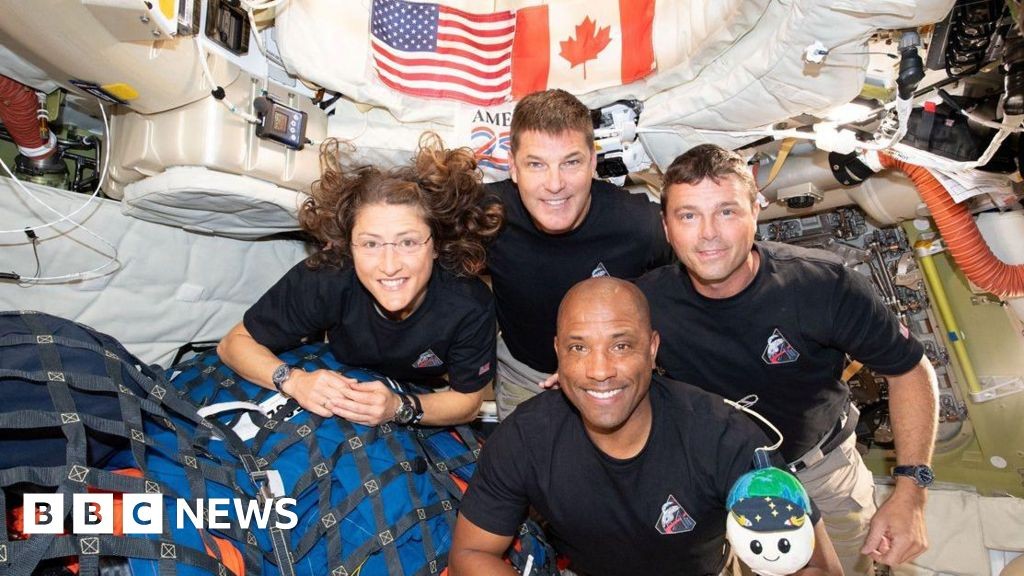
The recent historic flyby by NASA’s Artemis II mission highlighted a persistent challenge in deep-space exploration: the “blackout” zone. As astronauts traveled behind the Moon, they experienced a 40-minute period of total silence, cut off from mission control on Earth. To solve this problem, Surrey-based Surrey Satellite Technology Ltd (SSTL) is developing a specialized spacecraft designed to act as a communication bridge.
The Problem: The Lunar Shadow
The physics of space communication are straightforward but restrictive. Radio and laser signals travel in straight lines; for a signal to reach a spacecraft, there must be a clear line of sight between the transmitter and the receiver.
When a mission—whether it is a crewed capsule like Orion or a robotic rover—moves behind the Moon, the lunar mass acts as a physical shield, blocking all direct signals to Earth. During the Artemis II flyby, this resulted in a 40-minute communications blackout, leaving the crew temporarily isolated from Houston.
The Solution: Lunar Pathfinder
SSTL is currently building Lunar Pathfinder, a spacecraft scheduled for launch in spring 2027. Its primary purpose is to serve as a relay station to ensure continuous connectivity.
The mechanism is relatively simple but vital:
1. Relay Point: A spacecraft on the far side of the Moon sends its data up to Lunar Pathfinder.
2. Signal Bounce: Because Lunar Pathfinder maintains a line of sight with Earth, it “bounces” the information back to mission control.
3. Continuous Link: This allows rovers, orbiters, and crewed missions to stay in constant contact, even when they are physically obscured by the Moon.
Why This Matters for the Future of Space Exploration
This technology is not just a convenience; it is a requirement for the next era of lunar activity. As NASA aims to return humans to the lunar surface by 2028 and the European Space Agency (ESA) expands its Moonlight programme, the demand for reliable infrastructure is skyrocketing.
- Safety: Constant communication is critical for monitoring astronaut health and managing emergency situations.
- Robotic Exploration: For rovers to perform complex tasks on the lunar far side, they require real-time instructions and data transmission.
- Scientific Continuity: While the Artemis II crew used their blackout period to conduct geological studies and photography, constant connectivity would allow for real-time data sharing and more efficient mission management.
“Any time that a spacecraft is flying behind the Moon… if you can’t see the Earth, you can’t communicate. That’s where our Lunar Pathfinder will come in, because it can relay the information.” — Andrew Cawthorne, Managing Director of SSTL
Conclusion
As humanity moves toward permanent lunar presence, overcoming the physical barriers of the Moon is essential. The Lunar Pathfinder represents a critical step in building the orbital infrastructure necessary to turn the Moon from a destination into a connected frontier.