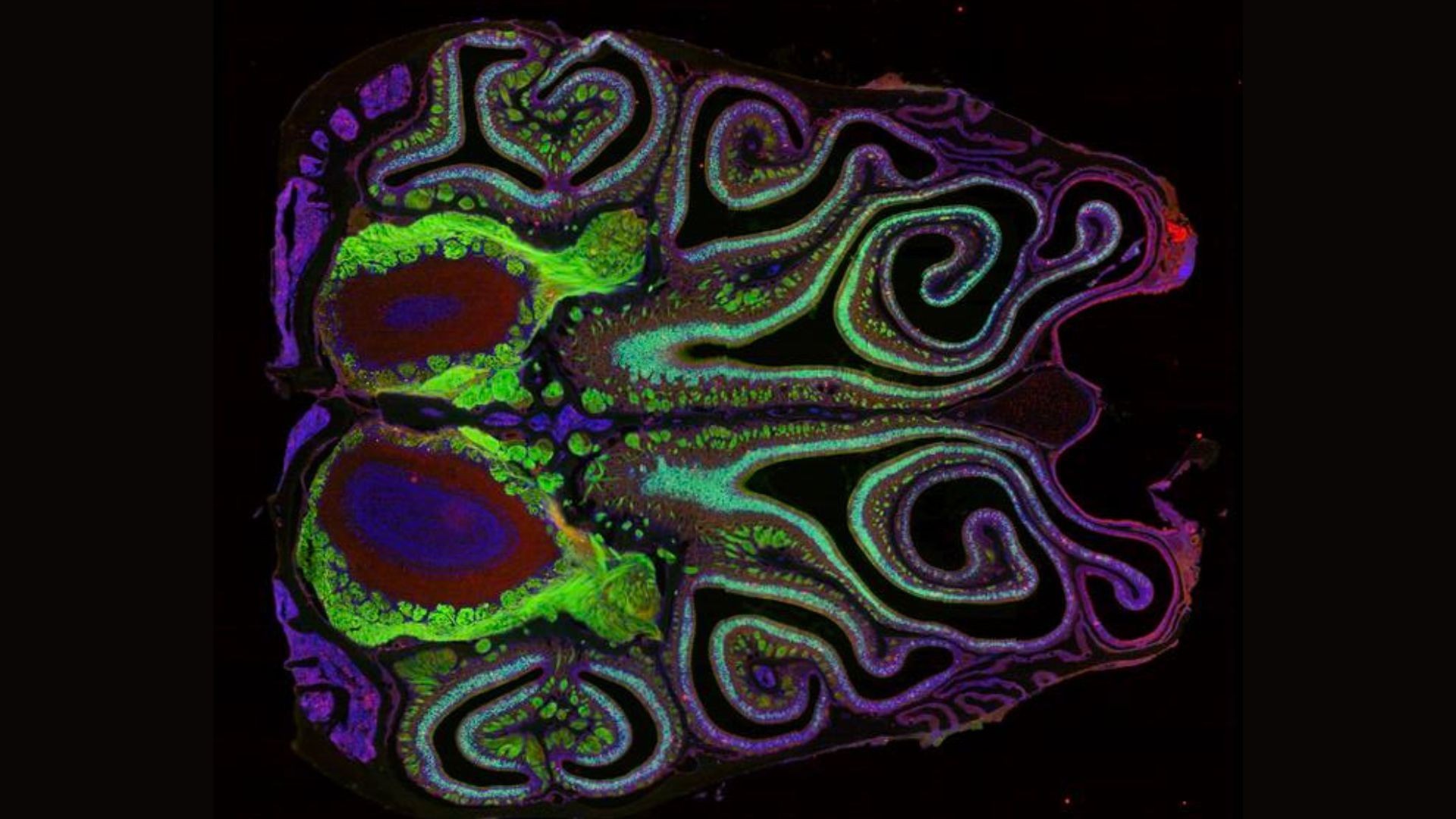
For decades, the scientific community operated under the assumption that the sense of smell was a somewhat chaotic affair. It was believed that olfactory receptors—the specialized cells responsible for detecting odors—were scattered randomly throughout the nasal lining. However, a groundbreaking new study has overturned this concept, revealing that the nose is actually a highly structured and precisely organized sensory organ.
From Randomness to Order
Published in the journal Cell, the research presents the first comprehensive map of smell receptors in the mouse nose. By utilizing advanced genetic technologies, researchers discovered that these receptors are not scattered at random; instead, they are arranged in tight, organized bands resembling a series of stripes.
The complexity of this system is staggering. While humans have only three main types of visual receptors for color, a mouse possesses roughly 20 million olfactory neurons capable of expressing more than 1,100 different types of receptors. Each receptor is responsible for detecting a specific type of scent, and the study shows that these different types are distributed in approximately a thousand distinct, overlapping stripes.
The Technology Behind the Discovery
The team, led by Dr. Sandeep Datta of Harvard Medical School, achieved this breakthrough by combining two cutting-edge techniques:
- Single-cell sequencing: This allowed researchers to examine individual mature olfactory neurons one by one to identify exactly which receptor each cell was expressing.
- Spatial transcriptomics: This technique enabled the team to pinpoint the exact physical location of those specific receptors within the nasal cavity.
By analyzing 5.5 million neurons across more than 300 mice, the researchers found that this organizational pattern is remarkably consistent; the “map” of receptors was essentially identical across every specimen studied.
A Direct Link Between Nose and Brain
Perhaps the most significant finding is that this physical organization in the nose is not an isolated phenomenon. The study revealed a direct correlation between the nasal structure and the brain’s processing center.
“The map in the nose is precisely aligned with the map in the brain,” noted Dr. Datta.
Neurons that express the same receptor in the nose all target the same specific location within the olfactory bulb (the brain’s primary smell-processing center). This suggests a highly efficient, “hard-wired” system where sensory input is organized spatially from the moment it enters the body until it reaches the brain.
The Role of Retinoic Acid
The researchers also identified a potential biological “architect” for this layout: a molecule called retinoic acid (RA). The study suggests that RA acts as a guide, instructing neurons on which receptor to express based on their location. When the researchers manipulated RA levels, the receptor map shifted, providing strong evidence that this molecule helps control the positioning and influence of olfactory neurons.
Why This Matters for Human Health
While this study focused on mice, the implications for human medicine are profound. The human olfactory system is structurally similar to that of a mouse, though we possess fewer total receptors.
Understanding the fundamental principles of how smell is organized could lead to breakthroughs in several areas:
– Treating Anosmia: Developing better treatments for the loss of smell.
– Mental Health: Addressing the psychological consequences of smell loss, such as an increased risk of depression.
– Neuroscience: Exploring how these biological “maps” function across different species.
Conclusion
By proving that the sense of smell relies on a highly organized spatial map rather than random distribution, this research provides a new blueprint for understanding how the brain perceives the world. This discovery shifts the focus of olfactory science toward understanding how these precise biological patterns are formed and how they might be restored in humans.