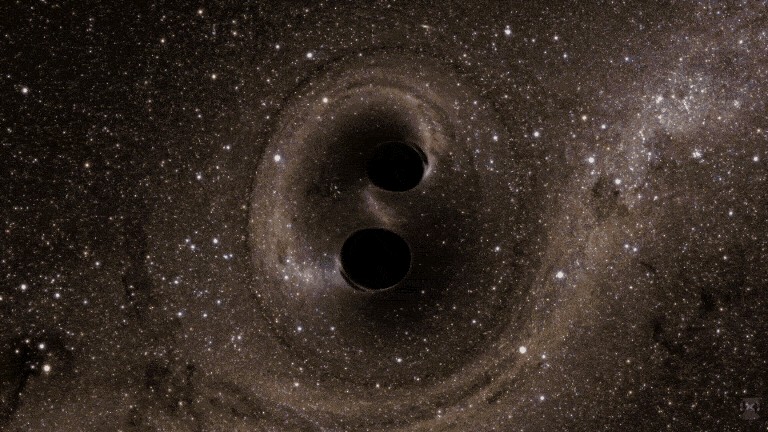
Scientists have once again validated Albert Einstein’s theory of general relativity with the detection of the most powerful gravitational wave to date, dubbed GW250114. This event, originating from the collision of two 30-solar-mass black holes 1.3 billion light-years away, provides the strongest evidence yet supporting Einstein’s century-old theory.
Rigorous Testing Through Unprecedented Clarity
The gravitational wave was detected by the U.S.-based Laser Interferometer Gravitational-Wave Observatory (LIGO) on January 14, 2025. What sets this signal apart is its exceptional clarity – roughly three times sharper than the landmark 2015 detection that first confirmed gravitational waves. This enhanced precision allowed for a more thorough test of Einstein’s predictions than ever before.
The improvements in detector sensitivity, achieved through a decade of upgrades minimizing noise from sources like seismic activity, were crucial. The instruments were capable of measuring distortions in space-time 700 trillion times smaller than the width of a human hair.
The Black Hole “Ringdown” Reveals Further Confirmation
After the merger, the newly formed black hole briefly “rang down,” vibrating like a struck bell. This phase emits distinct gravitational wave patterns (“tones”) that encode the black hole’s mass and spin. In GW250114, researchers detected two primary tones predicted by general relativity, with both measurements aligning perfectly – reinforcing the theory’s accuracy.
For the first time, scientists also identified a subtle “overtone” predicted by Einstein’s equations, appearing at the start of the ringing. This confirmation further strengthens the evidence for general relativity. Any discrepancy would have forced a reevaluation of our fundamental understanding of gravity.
Hawking’s Area Law Also Verified
Earlier analyses of GW250114 confirmed another major prediction: Stephen Hawking’s area law, which states that a black hole’s surface area can never shrink. The combined surface area of the original black holes was about 93,000 square miles (roughly Oregon’s size). The resulting black hole’s surface area grew to 155,000 square miles (closer to California’s size), consistent with Hawking’s theory.
The Future of Gravity Research
Despite the continued success of general relativity, physicists acknowledge that it’s likely incomplete. The theory fails to explain dark matter, dark energy, or reconcile with quantum mechanics. The hope is that future gravitational wave detections will reveal subtle deviations from Einstein’s predictions, pointing towards new physics.
Next-generation detectors, like the planned Einstein Telescope in Europe and the Cosmic Explorer in the U.S., will be ten times more sensitive. They will detect lower-frequency waves from more massive black holes, probing entirely new classes of these cosmic objects. The European Laser Interferometer Space Antenna (LISA), launching in 2035, will observe gravitational waves from supermassive black holes, potentially revealing dozens of tones within a single merger event.
“We’re living in the regime where we don’t have enough data… Once LISA is online, we’ll be overwhelmed.”
With continued funding, future gravitational wave science promises to unlock further insights into the nature of gravity and the universe.