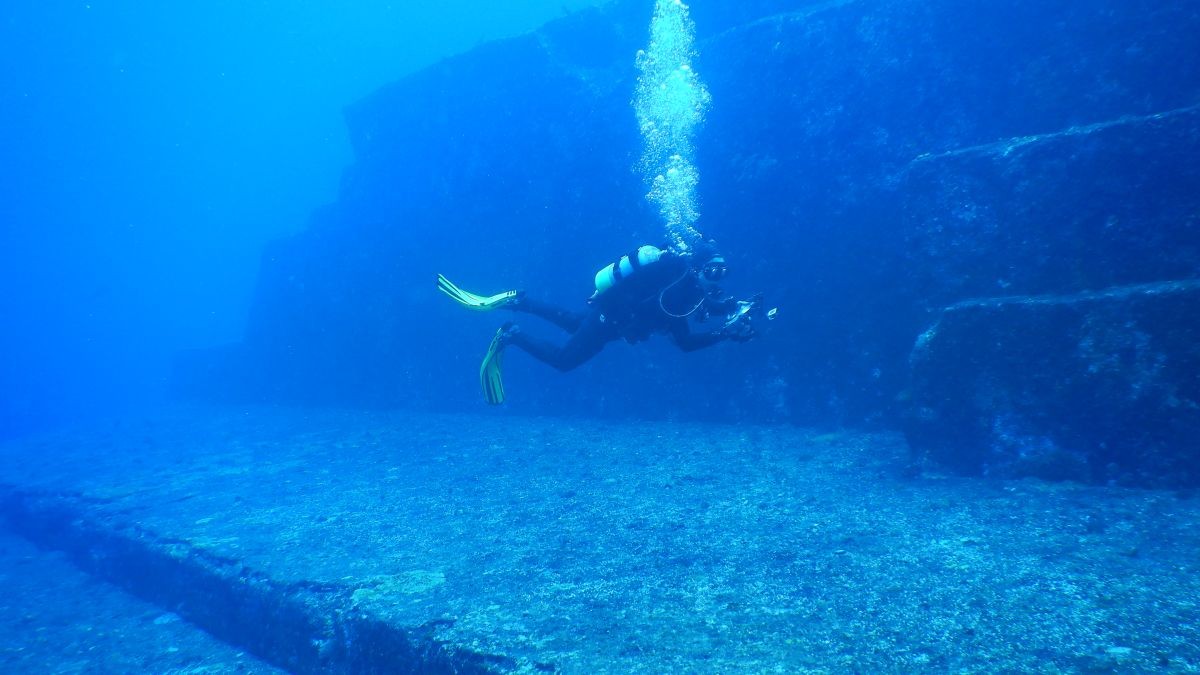
Off the coast of Yonaguni Island, Japan, lies an underwater formation that sparks debate. Resembling a submerged city, the Yonaguni Monument – first discovered in 1987 by Kihachiro Aratake – features sharply angled terraces and stepped structures that peak 6 meters below sea level. Is it the remains of a lost civilization, or a striking example of natural geological processes?
The Mystery Deepens
The structure’s unusually ordered appearance has led some to speculate that it was deliberately carved or modified by humans millennia ago. Geologist Masaaki Kimura has argued that the site shows evidence of artificial intervention, suggesting it could be a remnant of a civilization swallowed by rising seas around 10,000 years ago.
However, the majority of the scientific community disagrees. The prevailing explanation is that the formation is entirely natural, shaped over thousands of years by tectonic stress, fractures in the bedrock, and relentless erosion.
Nature’s Geometric Artistry
The key to understanding Yonaguni lies in understanding how Earth creates striking geometric formations without human intervention. The hexagonal columns of Ireland’s Giant’s Causeway, the tessellated pavements of Tasmania, and the perfectly split Al Naslaa rock in Saudi Arabia are just a few examples. These wonders demonstrate that nature is capable of astonishing precision.
The Yonaguni Monument formed along bedding planes – natural layers in sedimentary rock – and joint sets, which are fractures that develop when rock is stressed. Earthquakes, common in the region, accelerate this process, causing the rock to fracture in predictable patterns. The relentless action of ocean currents further erodes these fractures, creating the stepped appearance.
The Verdict: Natural Erosion
Recent research supports the natural origin theory. A team led by Hironobu Suga of Kyushu University observed ongoing erosion processes at the site in 2024, finding evidence of bedrock detachment, abrasion, and pothole formation. The team concluded that the “ruin-like formations” are actively being created by natural weathering.
No archaeological evidence has ever been found to suggest human involvement. Despite the lingering mystery, the most plausible explanation is that the Yonaguni Monument is a testament to Earth’s raw geological power, not a lost civilization. The fact that nature can craft such awe-inspiring structures through time and tectonic activity is remarkable enough.