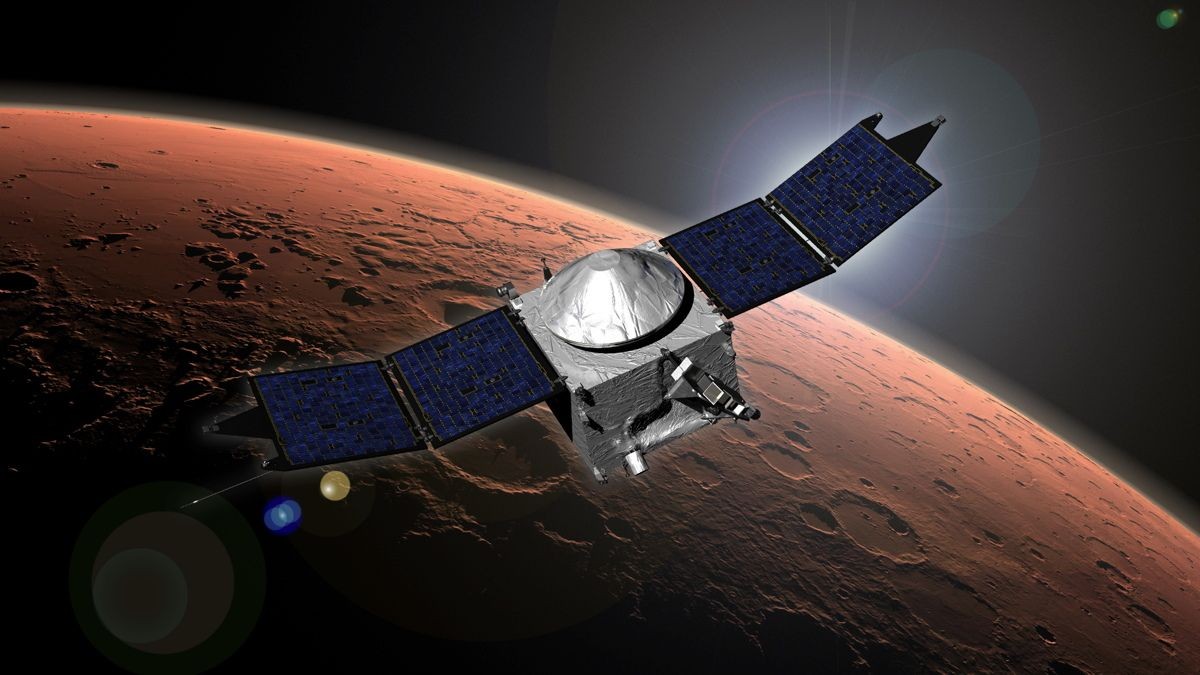
Despite months of silence, NASA continues to search for the MAVEN spacecraft, which lost contact in December 2025. The probe’s sudden outage occurred as it emerged from behind Mars, with initial telemetry showing no issues before communication abruptly ceased. Analysis suggests an unexpected spin during re-emergence, knocking MAVEN off its planned orbit.
Prolonged Silence and Recovery Efforts
NASA has deployed the Deep Space Network and the Green Bank Observatory in attempts to regain contact, but so far, all efforts have failed. Even directing the Curiosity rover to scan the sky for MAVEN has yielded no results. While officials acknowledge recovery is “very unlikely” after over a month of silence, the agency has not officially declared the mission lost.
This persistence is not merely sentimental; MAVEN played a critical role in relaying roughly 20% of communications between Earth and the Curiosity and Perseverance rovers. Its loss shifts a greater burden onto other orbiters, such as the Mars Reconnaissance Orbiter, Mars Odyssey, and ESA’s Trace Gas Orbiter.
MAVEN’s Legacy and Future Plans
Launched in 2013, MAVEN exceeded expectations, operating for over a decade instead of the initial one-year lifespan. Its primary mission was to study the atmospheric erosion of Mars, providing vital insights into how the planet transformed from a potentially habitable world into the cold desert we see today.
However, the probe’s failure highlights a broader issue: aging infrastructure in deep space. NASA is already considering a replacement, with a $700 million budget allocated for a new high-performance Mars telecommunications orbiter. Private companies like Blue Origin are also proposing solutions, potentially launching a dedicated telecom orbiter by 2028.
“We know that they’re not all going to last forever,” stated NASA’s planetary science director, Louise Prockter, underscoring the inevitable need for infrastructure upgrades in long-term Mars exploration.
The ongoing search for MAVEN serves as both a testament to the dedication of the mission team and a reminder that even the most successful missions eventually reach their limits. NASA remains committed to maintaining Martian communications, whether by recovering MAVEN or building the next generation of relay infrastructure.