


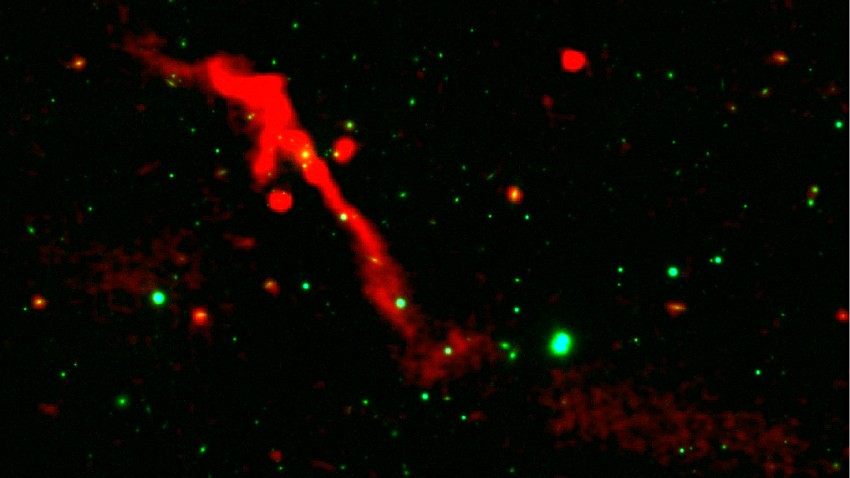
Scientists have observed a supermassive black hole at the center of a distant galaxy abruptly resuming activity after an estimated 100 million-year dormancy. The galaxy, designated J1007+3540, is emitting intense radio waves as the black hole reignites, sending powerful jets of plasma hurtling into space. This event provides a rare glimpse into the cyclical behavior of active galactic nuclei (AGNs) – the energetic cores of galaxies powered by supermassive black holes.
The “Cosmic Volcano” Erupts Again
The reawakening was detected through radio emissions, revealing that the black hole previously expelled vast jets of plasma stretching hundreds of thousands of light-years before falling silent. Now, those same jets have reactivated, interacting chaotically with the superheated gas surrounding the galaxy. This phenomenon is akin to a cosmic volcano erupting after centuries of calm, as described by study co-author Shobha Kumari. The scale of these structures – spanning nearly a million light-years – underscores the immense power at play.
Why Do Black Holes “Sleep” and Wake Up?
Only a minority of supermassive black holes exhibit these radio jets, typically found in galaxies where a swirling disk of dust and plasma feeds the black hole. This infalling matter generates magnetic fields that launch jets of matter outward. The on-off switching of these jets is infrequent, but not unheard of. Changes in the disk’s feeding patterns can trigger these shifts.
The research, published in the Monthly Notices of the Royal Astronomical Society, utilized the Low-Frequency Array (LOFAR) radio telescope network to analyze over 20 galaxy clusters with irregularly shaped jets. J1007+3540 stood out due to its layered jet structure: older lobes dating back 240 million years, overlaid with newer, brighter jets only 140 million years old.
The Interplay Between Jets and Intergalactic Gas
The space between galaxies within the cluster containing J1007+3540 is filled with extremely hot gas called the intracluster medium. This gas significantly influences the shape and direction of the reawakened jets. One older jet lobe is compressed sideways by the surrounding gas, while the other exhibits a kinked tail, indicating varying interactions with the medium.
“J1007+3540 is one of the clearest examples of episodic AGN activity, where the surrounding hot gas bends, compresses, and distorts the jets,” explains co-author Surajit Pal.
Future Research and Implications
The study of J1007+3540 will help scientists better understand how frequently AGNs cycle between active and dormant states, and how old jets interact with the intergalactic environment. Future high-resolution observations are planned to map the jet propagation through the intracluster medium in detail. This research will refine our understanding of black hole behavior, galaxy evolution, and the dynamics of the universe at large.
Ultimately, this discovery highlights the dynamic nature of galactic cores and the complex interplay between black holes, their host galaxies, and the surrounding cosmic environment.


