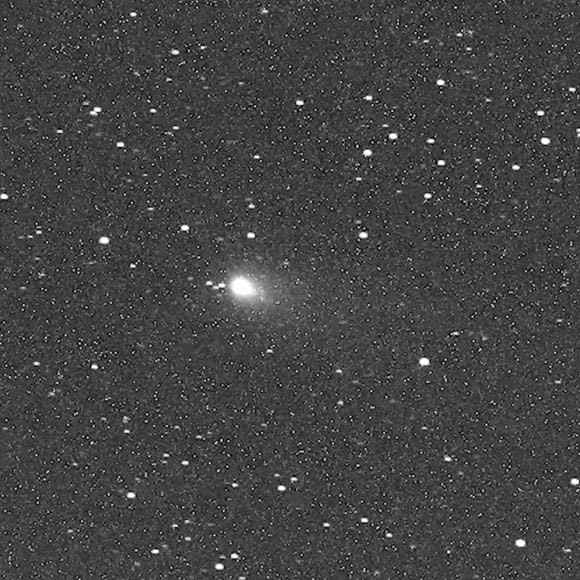
In an extraordinary feat of rapid scientific adaptation, the European Space Agency’s (ESA) Juice spacecraft has collected unprecedented data on interstellar comet 3I/ATLAS – an object originating from outside our Solar System. This unexpected encounter highlights the growing frequency with which such visitors are being detected, and the agility required to study them effectively.
Discovery and Unconventional Trajectory
First observed on July 1, 2025, by the NASA-funded ATLAS survey telescope in Chile, 3I/ATLAS immediately stood out due to its extreme orbital characteristics. Also designated C/2025 N1 (ATLAS) and A11pl3Z, the comet enters our system from the Sagittarius constellation, following a path unlike anything previously observed. Its speed and trajectory confirm its interstellar origin, meaning it formed around another star before being ejected into the galactic void.
A Fleeting Close Approach
The comet made its closest approach to the Sun (perihelion) on October 30, 2025, passing within 1.4 AU – just inside the orbit of Mars. This proximity provided a rare window for observation. Scientists realized quickly that Juice, en route to Jupiter, would offer a unique vantage point impossible to achieve from Earth-based telescopes.
Rapid Response and Data Collection
The ESA team swiftly re-prioritized Juice’s mission to maximize the encounter. Despite the usual nine-month lead time for complex operations, preparations were compressed into weeks. Between November 2nd and 25th, 2025, Juice employed five instruments – JANUS, MAJIS, UVS, SWI, and PEP – to measure the comet’s composition and behavior. Thermal constraints limited observations to a total of 12.5 hours, yielding 11.18 Gbits of data distributed across 126 science files.
Delayed Gratification: Data Transmission
The data remained locked until Juice entered a “cold-cruise” phase in mid-January 2026, allowing for high-bandwidth transmissions. In February 2026, two eleven-hour downlink sessions via ESA’s deep space antennas in New Norcia and Malargüe finally delivered the results to waiting scientists. The team celebrated a successful operation, demonstrating how quickly a spacecraft can adapt to unforeseen opportunities.
Implications and Future Missions
This event not only yielded valuable data on an interstellar visitor but also proved Juice’s operational flexibility. The spacecraft is now primed for its primary mission: conducting frequent flybys of Jupiter’s icy moons. According to Juice spacecraft operations engineer Federico Giannetto, this campaign has reinforced confidence in the team’s ability to quickly adapt and execute complex scientific objectives with limited warning.
The increasing number of interstellar objects discovered – such as ‘Oumuamua and 2I/Borisov – suggests these visitors may be more common than previously thought. Their study is crucial to understanding the formation and evolution of other planetary systems. Juice’s successful interception of 3I/ATLAS sets a precedent for future missions, demonstrating how spacecraft can capitalize on unexpected opportunities to unlock the secrets of the cosmos.