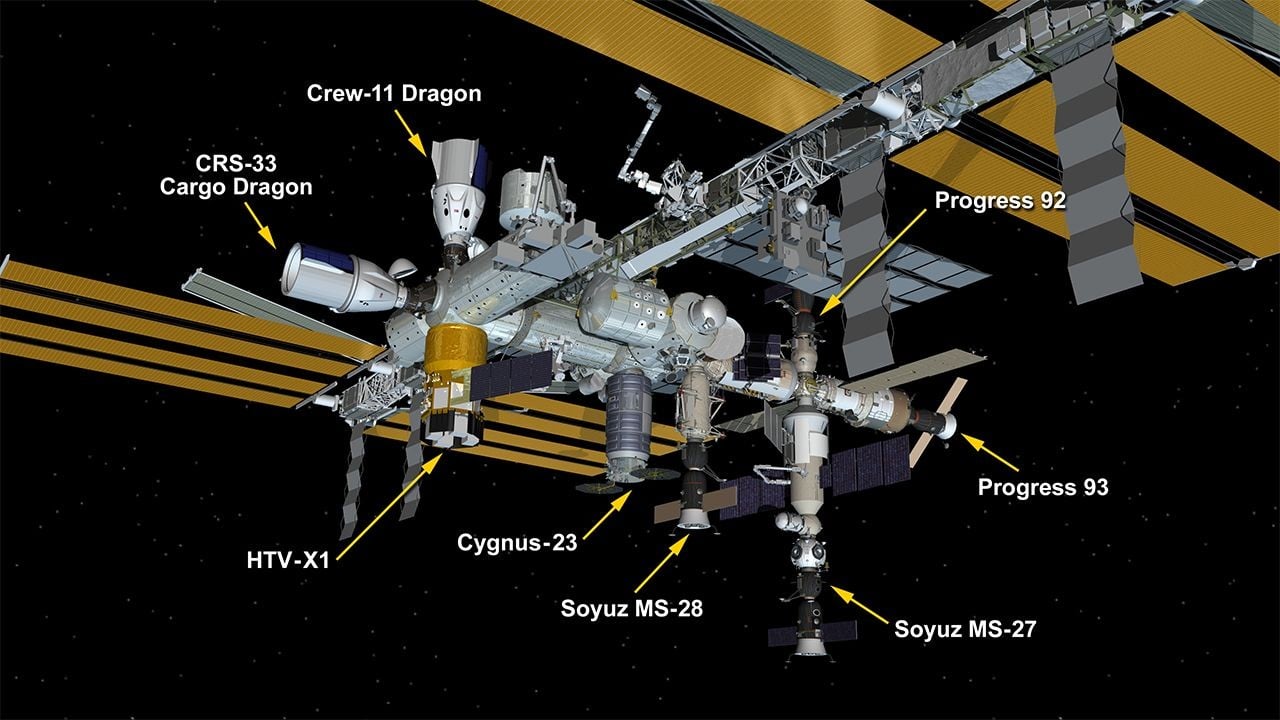
The International Space Station (ISS) has reached a historic milestone: for the first time, all eight of its spacecraft docking ports are simultaneously occupied. This unprecedented crowding highlights the increasing reliance on the ISS for both crew and cargo transport, as well as the logistical challenges of coordinating space traffic in low Earth orbit.
The Crowded Station
NASA confirmed on December 1st that every available docking space on the ISS is currently in use. The situation forced Mission Control to temporarily reposition a cargo spacecraft last week to accommodate the arrival of the latest crew, demonstrating the station’s limited capacity. The recent arrival of the Soyuz MS-28 spacecraft, carrying NASA astronaut Chris Williams and Roscosmos cosmonauts Sergey Kud-Sverchkov and Sergei Mikaev, pushed the ISS to its maximum occupancy.
Managing Space Traffic
To clear a path for the Soyuz crew, NASA used the ISS’s robotic Canadarm2 to move Northrop Grumman’s Cygnus-23 cargo vessel. This maneuver ensured safe docking for the incoming spacecraft before returning the cargo ship to its original position on the Unity module. The incident underscores the intricate planning required to manage spacecraft arrivals and departures at the ISS.
Current Occupants
Currently docked at the ISS are:
- Two Russian Soyuz spacecraft: One, Soyuz MS-27, is preparing for departure on December 8th with its crew, while the other, Soyuz MS-28, just arrived.
- Two Russian Progress cargo ships: Residing at the Poisk and Zvezda modules.
- One Japanese HTV-X1 cargo craft: Berthed at the Harmony Node 2’s nadir port.
- Two SpaceX Dragon capsules: One carrying cargo (CRS-33) and the other hosting the Crew-11 mission.
Implications and Future Outlook
The ISS’s full occupancy reflects the growing demand for space-based operations, including scientific research, technology demonstrations, and international collaboration. As more spacecraft become available for ISS access, the need for efficient traffic management will only increase. The departure of Soyuz MS-27 will temporarily alleviate congestion, but future missions will likely push the station back to its capacity limits.
The situation underscores that the ISS has become a vital hub for space activity, but maintaining its functionality will require careful coordination and potentially, future expansion of docking capabilities.