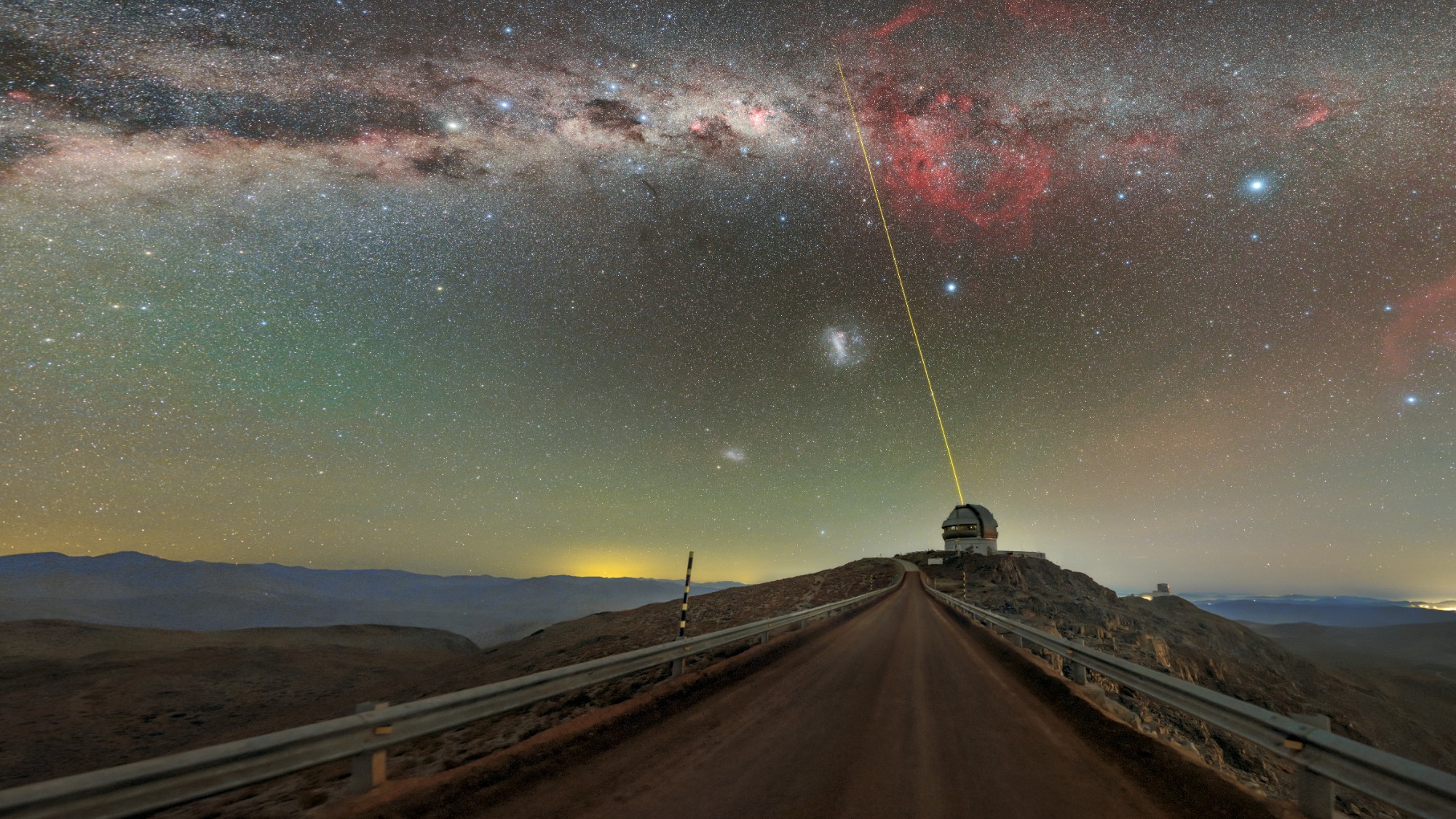
Cerro Pachón. Central Chile. It’s dark there, but not for the reason you might think.
A beam of pure energy slices upward from the Gemini South Observatory, punching a hole straight through the Milky Way’s dense heart. On July 16, 2
026, Petr Horálek caught this. He works for NOIRLab, an audiovisual ambassador really, capturing moments where technology bleeds into art. The result looks almost like the observatory is being beamed up. Abducted by the universe, perhaps?
Nah.
There is no alien ship. No saucer waiting in the dark.
What you’re seeing is a laser guide star.
A fake star. Created by light. Used to fix the rest.
It’s a trick. A powerful laser creates the appearance of an artificial star in the night sky, a bright pinprong against the chaos above. This “fake” star serves as a rigid reference point. The telescope uses it to map distortions in the atmosphere, calibrating its instruments so it can see clearer, deeper, harder. The lens adjusts. The blur corrects itself.
The Gemini South Observatory sits at 26.6 feet wide (that’s an 8.1-meter primary mirror), part of a pair with its twin, Gemini North (or ‘Alopeke), perched on Mauna Kea in Hawaii. On this specific Chilean peak, the SOAR telescope also resides, smaller, at 13.4 feet wide. But here, the main character is the light.
Horálek’s frame does something clever. It pulls you in. Your eyes travel down the road, past the silence of the mountain, and up. Into the glow.
Why this spot? High altitude. No light pollution. The sky is clean enough to let the galaxy speak. In this photo, the galaxy screams. Gas and dust across our local universe flare in colors that pop right out of the black, rainbowing the center of the Milky Way. It is beautiful. Unapologetically so.
Does it feel like we’re intruding?
Maybe. But we’re just looking up, trying to understand where we fit. The laser goes on. The beam stays on. And somewhere, a telescope sees what the eye cannot.