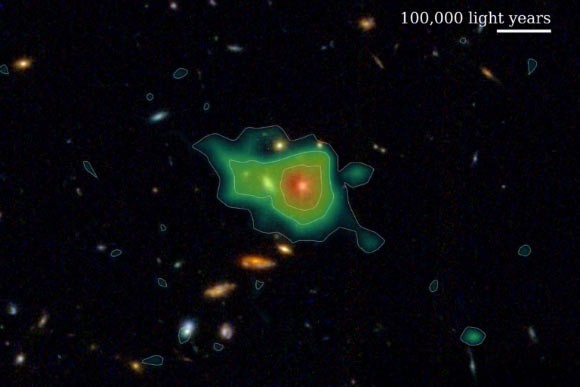
Astronomers using the Hobby-Eberly Telescope Dark Energy Experiment (HETDEX) have uncovered evidence of enormous hydrogen reservoirs—known as Lyman-alpha nebulae —surrounding more than 30,000 galaxies. These observations, dating back to a period 10 to 12 billion years ago, suggest that the raw materials required for galaxy growth were significantly more abundant in the early universe than previously estimated.
The Challenge of Seeing the Invisible
Detecting hydrogen gas is one of the most difficult tasks in observational astronomy. Because hydrogen does not emit its own light, it remains essentially invisible to standard telescopes.
To overcome this, astronomers look for a specific phenomenon: when hydrogen is near a high-energy source, such as a galaxy filled with ultraviolet-emitting stars, that energy causes the gas to glow. This “glow” allows scientists to map the presence of the gas, even if they cannot see the atoms directly.
Filling the “Missing Link” in Cosmic Observations
Until now, our understanding of these hydrogen halos has been limited by a significant observational gap:
– Previous surveys were often limited to detecting only the brightest, most extreme examples of these halos.
– Targeted observations tended to be too “zoomed in,” focusing on individual galaxies and missing the larger structures surrounding them.
This created a blind spot in our cosmic map, leaving astronomers unable to see the medium-sized structures that exist between small, localized clouds and massive, irregular blobs. The HETDEX findings are crucial because they bridge this gap, providing a more complete statistical picture of how gas is distributed around galaxies during “Cosmic Noon”—a period of intense star formation in the universe’s history.
Unprecedented Scale and Data
The scale of this discovery is driven by the sheer volume of data processed by the HETDEX team. Using the Hobby-Eberly Telescope at the McDonald Observatory, researchers have analyzed a massive swath of the sky—an area equivalent to over 2,000 full moons.
How the Discovery Was Made:
- Massive Data Collection: The team captured nearly half a petabyte of data, identifying over 1.6 million early galaxies.
- Statistical Selection: From this pool, researchers focused on the 70,000 brightest galaxies.
- Supercomputing Analysis: Using supercomputers at the Texas Advanced Computing Center, the team searched for signs of surrounding halos within these galaxy populations.
The resulting nebulae vary wildly in shape and size, ranging from tens of thousands to hundreds of thousands of light-years across. Some appear as simple, symmetrical clouds resembling footballs, while others are irregular, sprawling “amoeba-like” structures with long tendrils stretching into deep space.
Why This Matters
This discovery fundamentally changes our understanding of the “fuel” for galaxy evolution. If hydrogen was this widespread and abundant 10 billion years ago, it implies that galaxies had a much larger supply of gas to draw from to create new stars, potentially explaining the rapid growth and complexity observed in the early universe.
The detection of these vast reservoirs suggests that the early universe was far more “resource-rich” than our previous models indicated, providing the necessary scaffolding for the massive galaxies we see today.
Conclusion: By bridging the gap between small gas clouds and massive nebulae, HETDEX has revealed a much more abundant supply of hydrogen in the early universe, offering new insights into how galaxies grew and evolved across cosmic time.