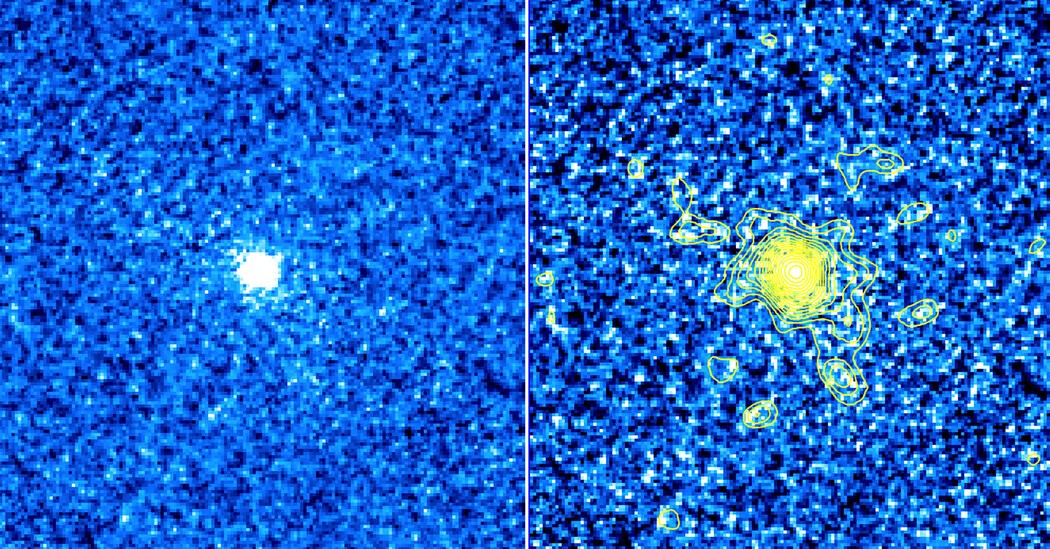
A comet known as 41P/Tuttle-Giacobini-Kresák exhibited an astonishing behavior in 2017: it abruptly stopped spinning and then began rotating in the opposite direction. This rare phenomenon, documented by astronomer David Jewitt using Hubble Space Telescope images, provides new insight into the dynamics of cometary rotation.
How Comets Spin and Why It Matters
Like most celestial bodies, comets naturally rotate due to their formation and interactions with gravity. However, comets are fragile, loosely-packed mixtures of ice, rock, and dust that break off from the outer solar system. As they approach the sun, solar radiation vaporizes their icy components, creating jets of gas and dust.
These jets aren’t uniform. Asymmetrically released material can act like a rocket engine, altering the comet’s spin. This is normal, but the scale and speed of the reversal observed in 41P were unprecedented.
The Reversal in Detail
Over several weeks, the comet’s rotation slowed to a complete stop before resuming in reverse. Jewitt, who published his findings on arXiv, noted that such dramatic shifts in spin had never been observed on this scale before. The exact mechanism behind the reversal remains partially unclear.
Dennis Bodewits, an astronomer at Auburn University, explained that the process involves jets of material blasting from the comet’s surface. While the specifics of jet formation are still under study, their impact on spin is undeniable.
Why This Is Significant
The reversal highlights how volatile comets are. Their surfaces aren’t solid, but constantly changing due to outgassing. This makes them unpredictable: a comet’s rotation is not fixed but subject to sudden and extreme changes.
This event is valuable because it reveals the power of small forces (gas jets) to alter the trajectory and behavior of larger objects in space. Understanding this effect is crucial for predicting the movement of comets, especially those that approach Earth, as well as modeling the evolution of smaller bodies in the solar system.
The spin reversal demonstrates that cometary dynamics are far more complex than previously assumed. Further study is necessary to fully understand how these jets form and their long-term impact on cometary evolution.
The unexpected behavior of 41P serves as a reminder that space is not always predictable, even for objects we’ve observed for decades.