A recent statistical analysis of archival sky surveys from the early Cold War era has uncovered a striking pattern: mysterious, short-lived bursts of light in the night sky appear to correlate with both above-ground nuclear weapons tests and reports of Unidentified Aerial Phenomena (UAPs).
The study, published in the journal Scientific Reports, examines data from the first Palomar Observatory Sky Survey, conducted between 1949 and 1957—a period before the launch of the first artificial satellite.
The Discovery of “Transients”
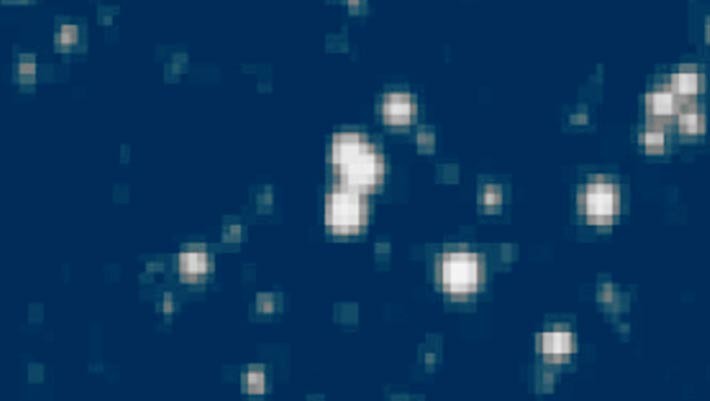
As part of the VASCO (Vanishing and Appearing Sources during a Century of Observations) project, researchers Dr. Beatriz Villarroel (Nordic Institute for Theoretical Physics) and Dr. Stephen Bruehl (Vanderbilt University Medical Center) identified over 100,000 “transients” on historical photographic plates.
These transients are described as:
– Short-lived: Lasting less than 50 minutes (the duration of a single exposure).
– Star-like: Appearing as distinct, point-like objects of light.
– Ephemeral: They appear in a single image but are absent in both preceding and subsequent surveys.
Crucially, the researchers noted that these flashes cannot be easily explained by common astronomical or technical issues, such as gravitational lensing, gamma-ray bursts, fragmenting asteroids, or simple defects on the photographic plates themselves.
Statistical Correlations
By comparing the timing of these flashes with historical records, the researchers found significant statistical links to two major categories of events:
- Nuclear Testing: The transients were approximately 45% more likely to occur on days surrounding an above-ground nuclear test (conducted by the US, USSR, or UK). This effect peaked the day after a test, when the likelihood of observing a transient rose by roughly 68%.
- UAP Sightings: There was a modest but consistent correlation between the number of transients and the frequency of UAP reports recorded in the UFOCAT database. On average, for every additional UAP sighting reported, the number of observed transients increased by about 8.5%.
What Could These Flashes Be?
While the study does not prove a direct cause-and-effect relationship, it challenges the idea that these flashes are merely “noise” or photographic errors. The researchers propose two primary, though unproven, hypotheses:
- Atmospheric Phenomena: Nuclear detonations might trigger previously unknown atmospheric reactions that produce brief, bright flashes of light.
- Orbital or High-Altitude Objects: Some transients might represent objects at high altitudes or in orbit—potentially the same phenomena that triggered UAP sightings.
“Our findings provide additional empirical support for the validity of the UAP phenomenon and its potential connection to nuclear weapons activity, contributing data beyond eyewitness reports.”
Why This Matters
This research is significant because it moves the conversation regarding UAPs away from purely anecdotal eyewitness accounts and toward systematic, peer-reviewed scientific data. By using archival astronomical surveys, scientists can look at “hard evidence” captured by telescopes decades ago.
The correlation with nuclear testing is particularly intriguing. If nuclear explosions are indeed triggering these light bursts, it suggests a physical interaction between high-energy weapons and the upper atmosphere (or perhaps objects within it) that we do not yet fully understand.
Conclusion
The study identifies a statistically significant link between 1950s sky transients, nuclear testing, and UAP reports, suggesting that these mysterious flashes may be tied to high-energy atmospheric events or unidentified aerial objects.