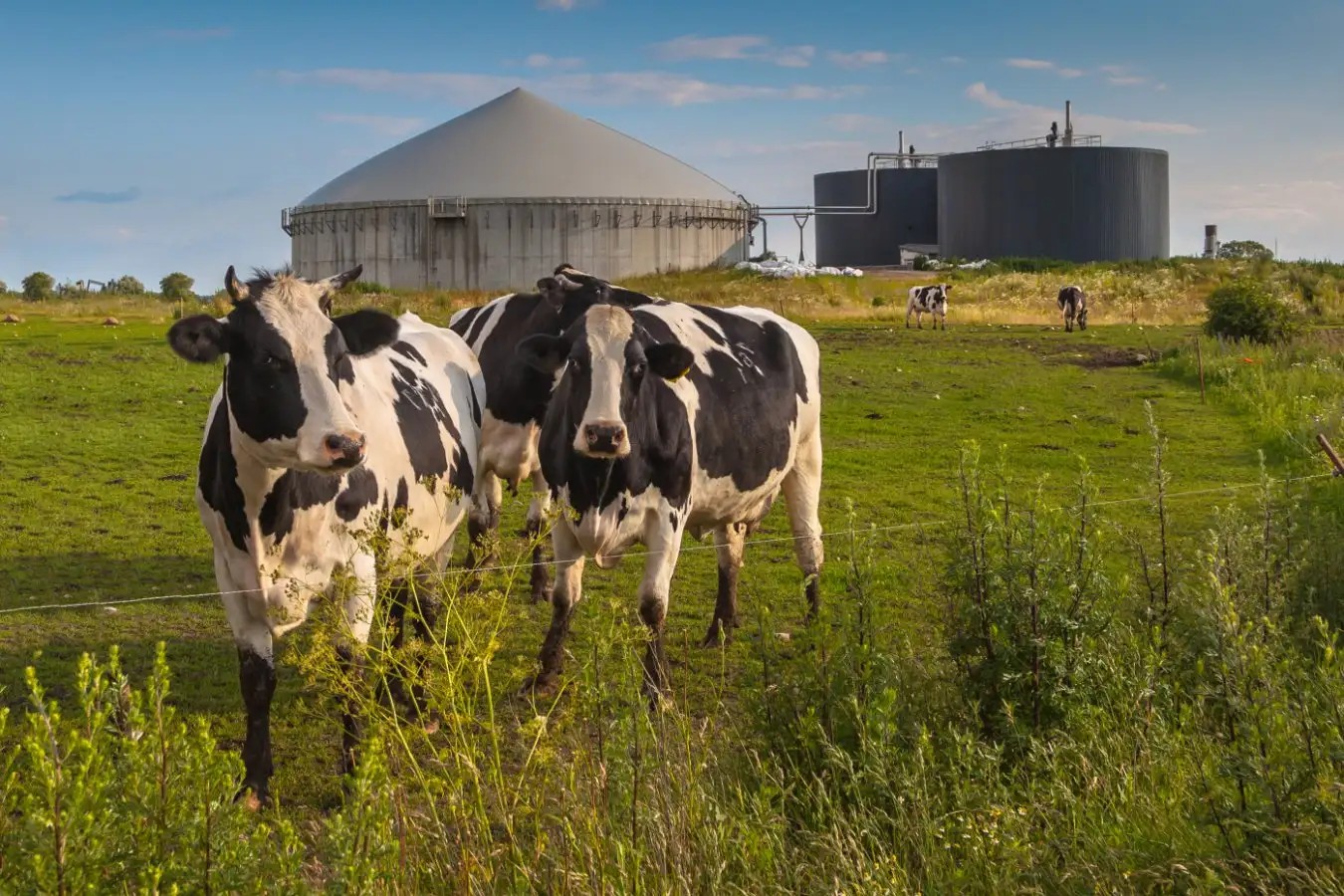
As governments worldwide seek ways to slash agricultural greenhouse gas emissions, a centuries-old concept is undergoing a high-tech revival. Anaerobic digesters —systems that capture methane from decomposing organic matter—are being heavily promoted as a primary tool for decarbonizing the dairy industry. However, recent research suggests that while these machines can significantly reduce emissions, they also introduce new environmental risks and economic distortions.
How Digesters Work: Turning Waste into Energy
The fundamental science behind a digester is relatively simple. When organic matter, such as cow manure, decomposes in an environment without oxygen, microbes produce a mixture of carbon dioxide and methane known as biogas.
In traditional dairy farming, manure is often stored in massive, open lagoons. As it breaks down, methane—a greenhouse gas far more potent than CO2—escapes freely into the atmosphere. A digester changes this process by:
– Capturing the gas: By placing manure in closed tanks or covering lagoons with plastic, the biogas is trapped and piped away.
– Generating energy: The captured gas can be burned for heat and electricity, purified into natural gas, or compressed for vehicle fuel.
– Recycling nutrients: The leftover digested manure is repurposed as fertilizer or animal bedding.
On paper, the benefits are striking: processed manure can emit 91% less methane during storage compared to untreated waste.
The “Cautionary Tale” of Leaks and Spikes
Despite their potential, digesters are not a perfect fix. A recent study of 98 dairy farms in California—a state that has invested $389 million in digester grants over the last decade—revealed several critical complications.
1. The Risk of Methane Leaks
Because digesters are heated to accelerate gas production, they create a concentrated source of methane. If the system is not perfectly sealed, leaks can occur. In some extreme cases, the study found that leaks resulted in methane emissions exceeding 1,000 kg per hour, potentially making the “solution” a larger emitter than the original open lagoon.
2. Construction-Phase Spikes
Researchers noted that methane emissions often spike during the actual construction of the digesters. While the exact cause is still being studied, it is believed that rerouting manure slurry during installation agitates the waste, causing a sudden release of gas.
3. “Pollution Swapping”
There is a growing concern regarding pollution swapping, where solving one problem creates another. Digesters can accelerate the formation of ammonia, a different pollutant, and if the biogas is burned off rather than captured and sold, it can release harmful hydrogen sulphide.
The Perverse Incentive: Scaling Up the Problem
Perhaps the most significant concern is not environmental, but structural. In many regions, including California, government incentives—such as credits for low-carbon fuel—make biogas a profitable commodity.
Experts warn that this creates a “perverse incentive structure.” When manure becomes a valuable byproduct, it begins to compete economically with milk. This effectively subsidizes the expansion of industrial dairy farms. One study indicated that receiving these incentives led to an average increase of 860 cows per herd, meaning the technology intended to mitigate climate change may actually be encouraging the growth of the very industry driving the emissions.
Conclusion
While anaerobic digesters remain one of the most effective tools for reducing livestock emissions, they are not a “set and forget” solution. To prevent them from becoming environmental liabilities or drivers of industrial expansion, policymakers must balance financial incentives with rigorous leak monitoring and a broader look at more holistic climate strategies.