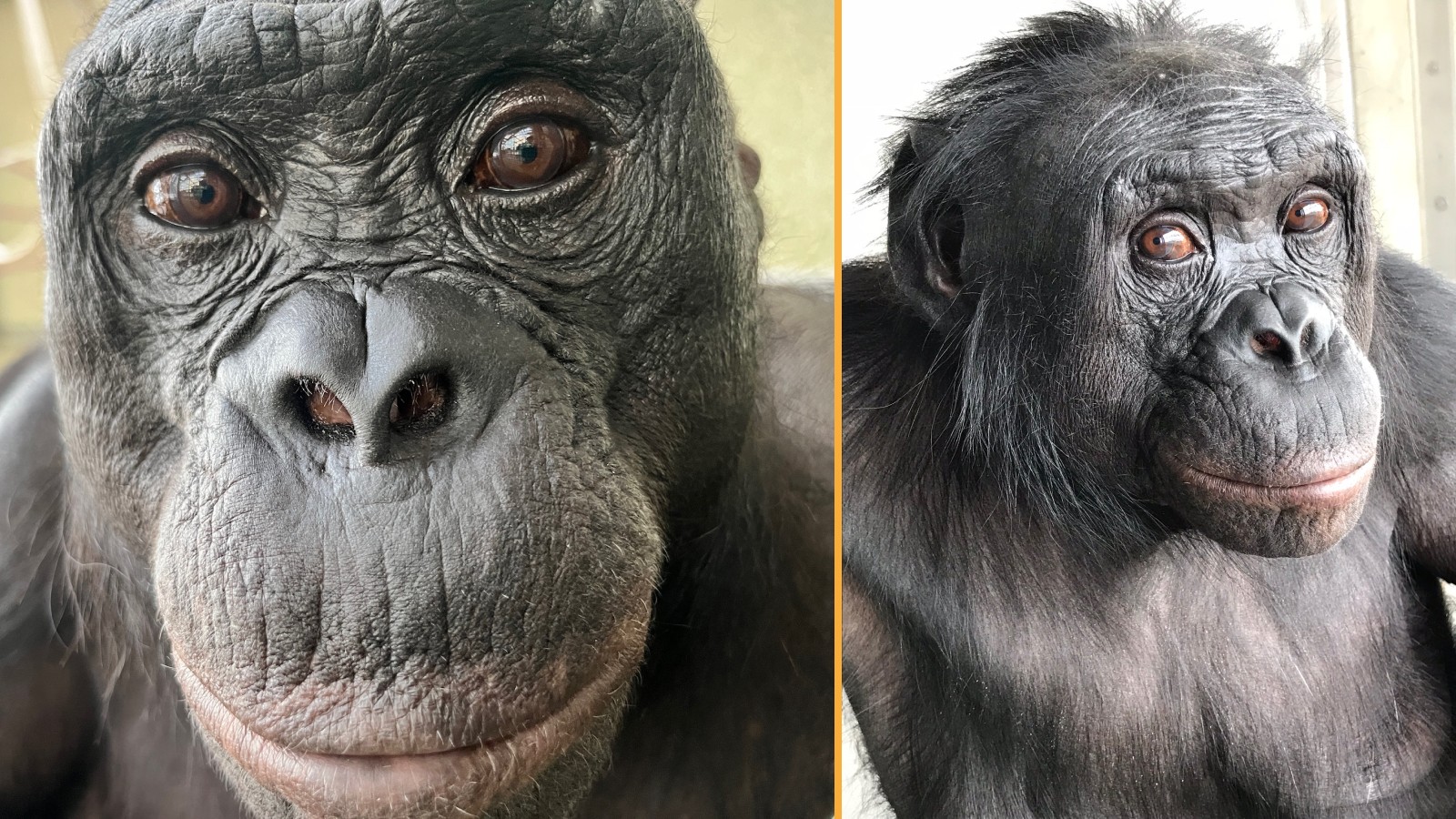
Scientists have experimentally confirmed that bonobos, one of our closest primate relatives, are capable of engaging in pretend play – a cognitive ability previously thought to be uniquely human. The study, published in Science, provides the first rigorous evidence that bonobos can track imaginary objects during simulated scenarios, suggesting this capacity may have evolved before the split between humans and bonobos over six million years ago.
The Kanzi Experiment: Tracking Imaginary Juice
The research centered on Kanzi, a deceased bonobo renowned for his exceptional comprehension of spoken English. Researchers designed an experiment where Kanzi was shown transparent cups and an empty jug. The scientists pretended to pour juice into one cup, then back into the jug, testing whether Kanzi could follow the imaginary transfer.
Kanzi correctly identified the location of the pretend juice 68% of the time, indicating an ability to track an object that did not physically exist. Crucially, follow-up tests confirmed Kanzi could distinguish between real and imaginary juice; he consistently chose the cup with actual juice over the one that had been “emptied” in a pretense scenario. A similar experiment with “pretend grapes” yielded comparable results.
Why This Matters: Beyond Anecdotal Evidence
Previous observations of wild and captive apes hinted at similar behavior – chimpanzees playing with discarded objects, bonobos mimicking eating from photographs. However, these anecdotes were open to alternative explanations (such as the animals genuinely believing the objects were real). This study removes that ambiguity by establishing clear experimental proof of imaginary object tracking.
The implications are significant. Pretend play is not merely a whimsical behavior; it is considered a fundamental building block for complex cognitive skills like imagination, planning, and social understanding. If this capacity exists in bonobos, it suggests it may be more deeply rooted in primate evolution than previously assumed.
Limitations and Future Research
The study was limited to a single bonobo, Kanzi, making broad generalizations premature. Researchers acknowledge Kanzi demonstrated an ability to follow pretend play initiated by humans, but not necessarily to initiate such scenarios independently.
Further research with other apes is needed to determine whether this ability is widespread within the species. If confirmed, it could rewrite our understanding of primate cognition and the evolution of human imagination.
“This is a huge development for our field,” says Laura Simone Lewis, an evolutionary anthropologist not involved in the study. “It provides direct evidence to support the anecdotal reports from the wild that our great ape cousins can use their imaginations.”